TheInCredible Messenger

For your role / Office & systems leaders

An office needs a job, authority, and a way to follow through.

Set up or run a violence prevention or neighborhood safety office. Learn how to connect agencies, give community partners a real role, and get funding and services moving.

← All rolesViolence prevention office (OVP) and neighborhood safety office (ONS) directors · mayors’ offices · police and public health leaders · policymakers · funders

Model design and implementation

Build the structure around the intervention.

Community violence intervention (CVI), Group Violence Intervention (GVI), and hospital-based violence intervention programs (HVIPs) serve different needs. Before choosing one, check whom it reaches, what staff and partners it needs, who can authorize the work, and how you will know it is being delivered.

The Mechanics of Community Violence Intervention

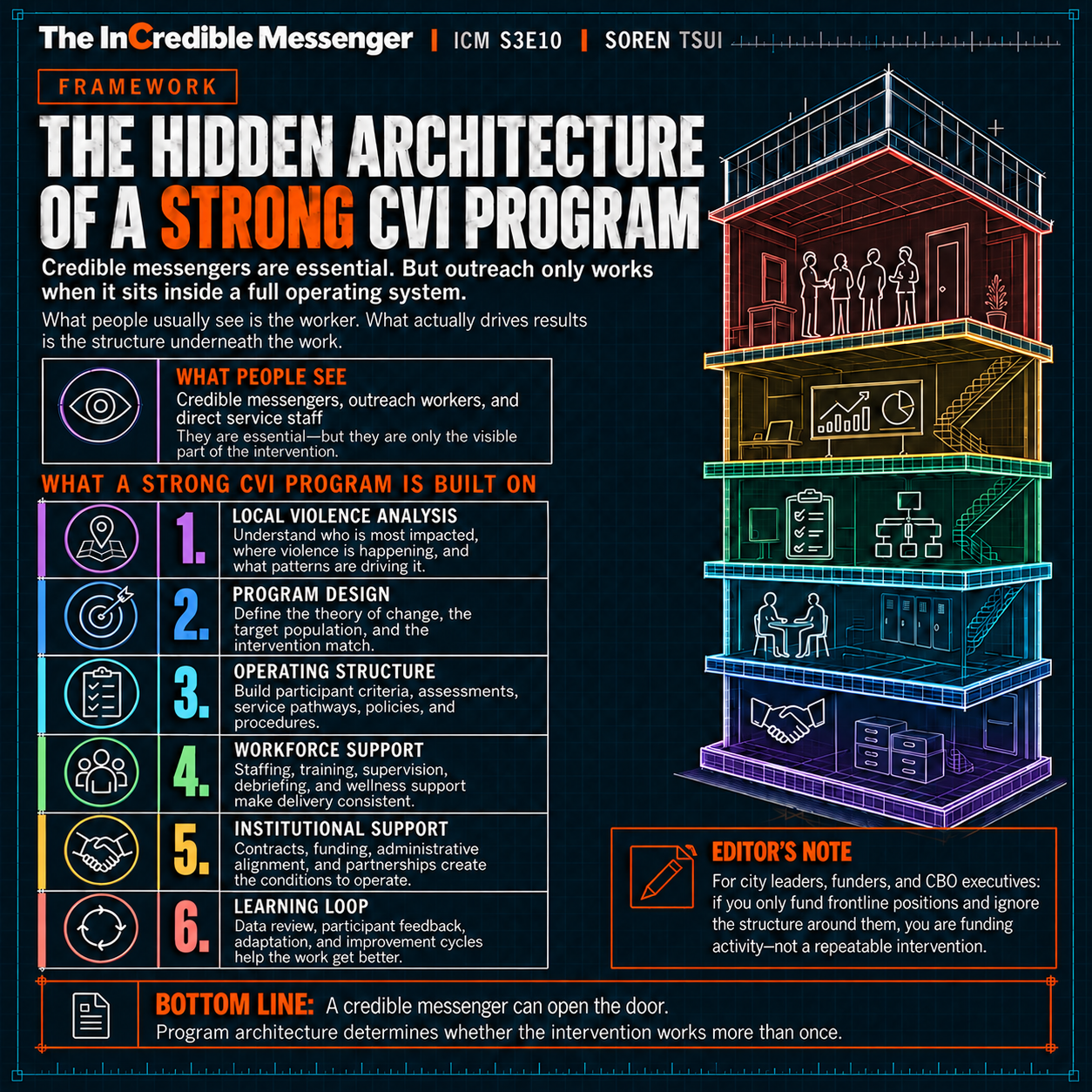
Soren Tsui episode infographic showing six foundations beneath visible frontline CVI work: local violence analysis, program design, operating structure, workforce support, institutional support, and a learning loop.

From the Soren Tsui episode: the structure supporting frontline community violence intervention.

View full-size graphic (opens in a new tab)
Read graphic text
  • Credible messengers are essential. Outreach works inside a full operating system; the visible worker is only part of the intervention.
  • Local violence analysis: understand who is most impacted, where violence is happening, and what patterns drive it.
  • Program design: define the theory of change, target population, and intervention match.
  • Operating structure: build participant criteria, assessments, service pathways, policies, and procedures.
  • Workforce support: staffing, training, supervision, debriefing, and wellness support make delivery consistent.
  • Institutional support: contracts, funding, administrative alignment, and partnerships create the conditions to operate.
  • Learning loop: data review, participant feedback, adaptation, and improvement cycles help the work get better.
  • Funding frontline positions without supporting the surrounding structure funds activity without a repeatable intervention. A credible messenger can open the door; program architecture determines whether the intervention works more than once.

This graphic maps the program structure behind frontline CVI. It describes a strong CVI program, not an entire jurisdiction’s public safety system.

From the CVI practice toolkit / office leadership

Support the people delivering the work.

After a difficult encounter, use supervision to examine the conditions your office or program can change. Give an owner and a date to any gap you identify.

Staff support / office practice

The worker support check

Protect judgment, safety, and continuity after a difficult encounter.

  1. Use supervision to review the decision and the conditions around it, without requiring personal disclosure.
  2. Name any coverage, safety, training, or partner gap that made the work harder.
  3. Assign an owner and date to fix the organizational gap.

Leadership check: Personal coping cannot replace staffing, pay, safe protocols, and responsive supervision.

Adapted from Jonathan McMillan’s How To Be An InCredible Messenger: Community Violence Intervention Toolkit (2025).

Illustrative situation · ICM application

The office has a budget. The partner cannot start.

An outreach provider is selected, but its contract and first payment are delayed. Workers have not been hired and residents still cannot reach the promised service. The director needs a timeline from procurement, finance, and the provider, with one person able to clear each delay. A council can identify the gap; the agency that holds the contract must act on it.

The useful output is a dated delivery plan showing the contract, payment, hiring, training, and first service. Review actual start dates and residents’ access at the next meeting. Use the implementation chain to trace the dependencies, then check the evidence and measures that fit the local decision.

Start here

Make the next move useful.

Turn a title and a budget into a working structure with clear decisions, reliable partners, and public accountability.

  1. 01

    Define the office’s job and authority

    Put the office’s authority, scope, budget, and relationship to the mayor, agencies, and community partners in writing. Name the decisions it owns and the ones it must influence.

  2. 02

    Map the whole response

    See how prevention, intervention, crisis response, recovery, and the conditions behind harm connect. A strong community violence intervention (CVI) program is one part of this picture.

  3. 03

    End reviews with a decision

    Meet regularly to review numbers, worker experience, and resident feedback. Leave with a decision, a responsible person, and a deadline. Tell residents what changed and why.

Set up and run the office

Build the operating structure before adding programs.

This is an ICM starting sequence. Adapt it to the legal mandate, local conditions, and the authority each partner actually holds.

Authority
Write down who can set priorities, approve spending, convene agencies, require information, and resolve stalled decisions.
Assessment
Combine local harm patterns, existing programs, community knowledge, service gaps, and failed handoffs. Do not select a model before the problem is clear.
Governance
Write down who can make each decision, who does the work, and who answers when it falls through. Give residents and workers a defined role in those decisions and pay for their time where possible.
Delivery
Assign a lead for every action across agencies and partners. Put contracts, staffing, training, data, and service start dates into the plan.
Learning
Review reach, service quality, participant experience, and outcomes. Record decisions and tell partners and residents what changed.

A new office can coordinate the system only when its responsibilities and decision rights are real.

Fund the field

Design community grants people can use and account for.

Follow the grant’s rules, then make the process usable: clear instructions, realistic payment dates, and reporting that helps you check the work without overwhelming small organizations.

Clear notice
State the purpose, eligible applicants and activities, decision criteria, allowed costs, timeline, and reporting expectations plainly.
Application help
Offer application help before the deadline. Share answers with all applicants so access to staff does not become an unfair advantage.
Realistic budget
Check whether staffing, training, supervision, data, administration, and worker support can be funded under the award.
Time to deliver
Track the gap between award, contract, payment, hiring, and the first service. Assign someone who can clear administrative delays.
Useful reporting
Ask for measures that inform decisions and give partners a chance to explain context, barriers, and changes in practice.

Learn from the work

Ideas and tools to use next.

These ICM resources connect a practical lesson to the framework or conversation it came from. Guest perspectives are identified as guest perspectives.

  • Framework

    Public safety architecture

    Connect prevention, intervention, response, recovery, authority, and accountability.

    Read this resource
  • Framework

    Community as infrastructure

    Build community knowledge, resources, and decision rights into the operating plan.

    Read this resource
  • ICM guide

    The implementation chain

    Trace every dependency between an approved strategy and services reaching people.

    Read this resource
  • ICM guide

    Community safety councils

    Give agencies and residents a structure for making and carrying out shared decisions.

    Read this resource
  • From Soren Tsui

    Diagnose the violence before choosing a model

    Compare the model’s operating requirements with the local pattern and capacity.

    Read this resource

Go to the source

Funding pages and application guidance

Read the original guidance and check funding notices directly. Eligibility, deadlines, allowable costs, and reporting rules come from each notice and can change.

  • Program example · prior notice

    BJA CVIPI

    The FY25 community violence intervention funding round is closed. Review its requirements as an example, then check current notices for any new round.

    Open source
  • Current notices

    OJP funding opportunities

    Open the current federal notices and read each notice for eligibility, dates, and rules.

    Open source
  • Current notices

    BJA available funding

    Review BJA opportunities, including relevant public-safety and intervention programs when offered.

    Open source
  • Current notices

    OJJDP open funding

    Check youth-focused opportunities and their specific eligibility rules.

    Open source
  • Federal search

    Grants.gov

    Search across federal agencies; confirm the complete notice before planning an application.

    Open source

Put it to work

Bring the right people into the same plan.

Work with Jonathan to clarify your office’s job, connect partners, fix a grant process, or build regular reviews that lead to action.

Explore ways to work together