CVI is one part of a larger plan
CVI must connect to prevention, emergency response, recovery services, and the agencies and organizations responsible for each part of the plan.
Season 3 • Systems design
Soren Tsui joins Jonathan McMillan to explain why CVI programs need clear roles, trained and supported staff, reliable funding, written procedures, and strong connections to the rest of a city's public-safety plan.
Framework from the episode
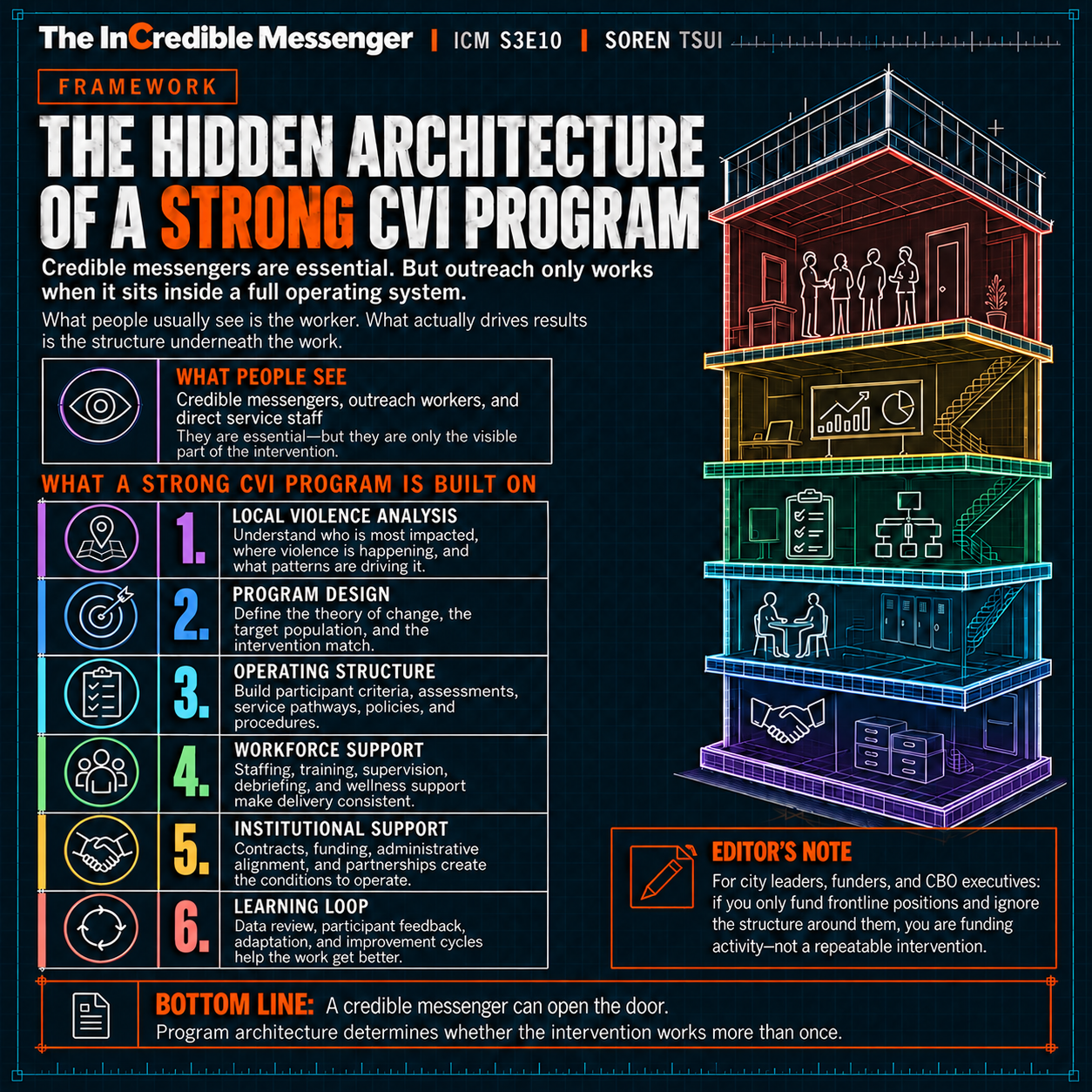
From the Soren Tsui episode: the structure supporting frontline community violence intervention.
View full-size graphic (opens in a new tab)The delivery sequence
First understand the local violence. Then choose an approach that fits, build the instructions and support to deliver it, and fund the people doing the work. Watch the silent sequence or read the same steps below.
Silent animation · 65 seconds. Use the player controls to play, pause, or replay.
View completed still (opens in a new tab)Companion collection
Use these maps and guides to see who does what, where a referral or decision gets stuck, and what to put in your local plan. Each resource is also in the Knowledge Library.
Framework
A structure for agencies, community partners, practitioners, and residents to make and carry out shared public-safety decisions.
System Map
An overview of the coordination needed to match a call with the right response, authority, and follow-through.
Implementation Guide
An overview of how a community safety council can turn shared priorities into an accountable violence-reduction plan.
Framework
Trace every step required to move from an approved strategy to consistent services in the community.
Field Brief
How training, supervision, trauma support, compensation, and career development affect the quality of violence-intervention services.
Episode Insight
Community participation changes decisions only when residents and practitioners have defined authority, information, and a route to act.
Episode Insight
A program tested elsewhere still needs to fit the violence happening here, the people affected, and what local partners can deliver.
Episode Insight
Partnerships, program design, and workforce investment must be built together; strength in one cannot compensate for neglect of the others.
Episode Insight
A policy's stated purpose is not evidence that it worked; leaders need a process for reviewing results and correcting harm.
CVI must connect to prevention, emergency response, recovery services, and the agencies and organizations responsible for each part of the plan.
The right response depends on the type and urgency of the need, the authority required, the relationship needed, and the follow-up available.
Policies, training, supervision, funding, staffing, and regular review determine whether a promising model is delivered consistently.