Frameworks · Episode visuals
See the parts. Make the next move.
Eight visual explanations from the Soren Tsui and Tristan Gross conversations. Play a sequence, select a part of the model, and see where delivery can break and what a team can do next. Use the episode and linked resources for the full context.
01 · From the Soren Tsui episode
The structure behind a strong CVI program
A worker needs more than a job title: a clear picture of local violence, an approach that fits, instructions for the work, worker support, agency backing, and regular checks that lead to improvements.
Question to take into the work
Which support is missing or too weak for a worker to deliver the intervention consistently?
This image maps a CVI program's operating structure. It does not describe the entire public safety system or prove effectiveness on its own.
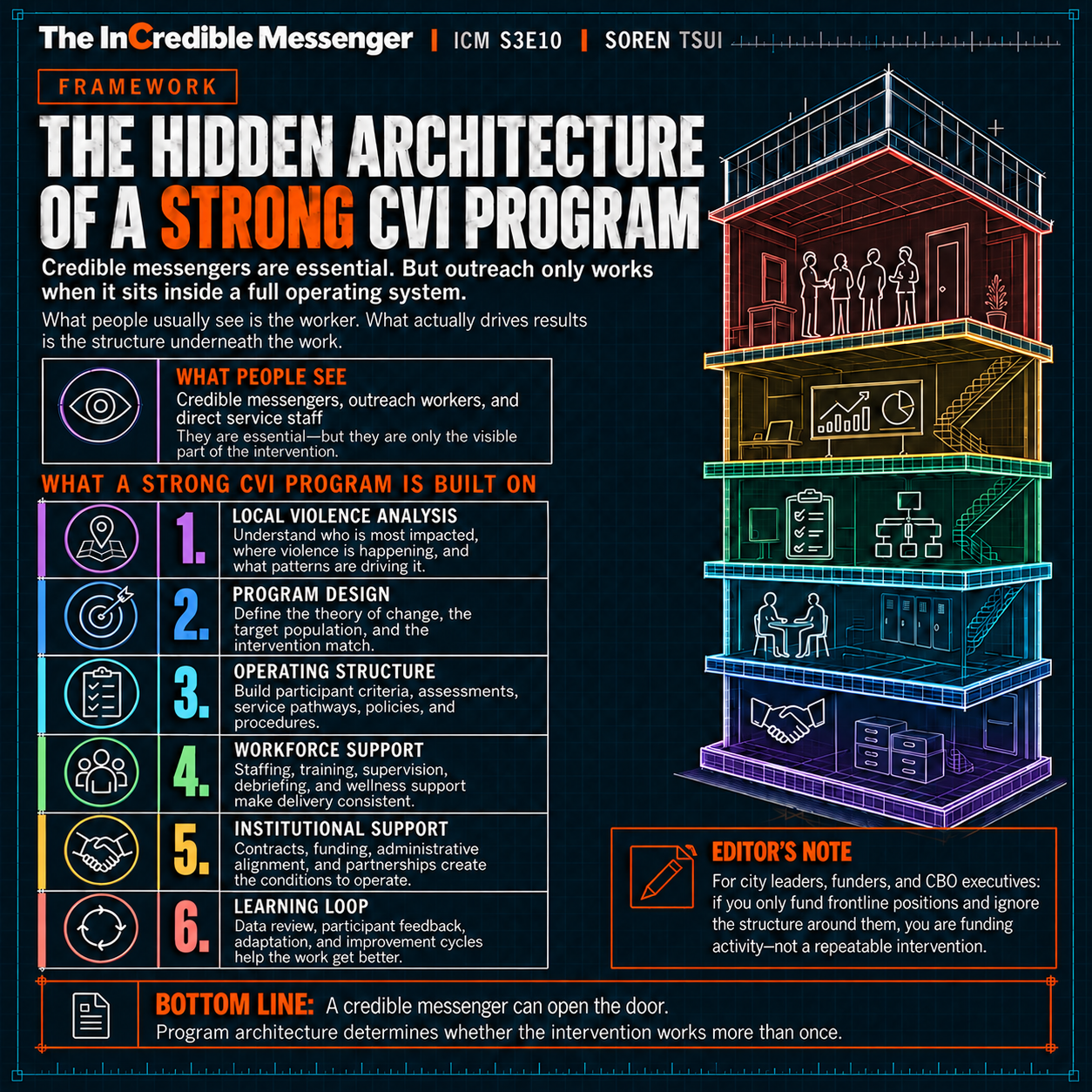
From the Soren Tsui episode: the structure supporting frontline community violence intervention.
View full-size graphic (opens in a new tab)Read graphic text
- Credible messengers are essential. Outreach works inside a full operating system; the visible worker is only part of the intervention.
- Local violence analysis: understand who is most impacted, where violence is happening, and what patterns drive it.
- Program design: define the theory of change, target population, and intervention match.
- Operating structure: build participant criteria, assessments, service pathways, policies, and procedures.
- Workforce support: staffing, training, supervision, debriefing, and wellness support make delivery consistent.
- Institutional support: contracts, funding, administrative alignment, and partnerships create the conditions to operate.
- Learning loop: data review, participant feedback, adaptation, and improvement cycles help the work get better.
- Funding frontline positions without supporting the surrounding structure funds activity without a repeatable intervention. A credible messenger can open the door; program architecture determines whether the intervention works more than once.
Illustrative application · ICM
Illustrative: A city funds outreach jobs but has no agreed way to assess a participant’s needs or support workers after difficult encounters. Assign someone to build those practices and fund the time they require.
ICM field application · illustrative
Trace one part at a time
Select a part to see what it does, where it can break down, and a next step your team can try. These are ICM planning examples drawn from the episode.
Local violence analysis
Identify the people, places, and patterns the response is meant to reach.
- Where it breaks
- The program targets a broad area without a shared picture of the harm or who is most affected.
- Next move
- Compare incident patterns with community knowledge and document the population and problem to address.
- Who needs to act
- Program lead, local analysts, and people close to the harm.
- Check the delivery
- Can partners explain why this population and response were chosen?
02 · From the Soren Tsui episode
From insight to impact
The sequence moves through diagnosing the violence problem, selecting an intervention that fits, building the manuals and procedures to deliver it, and resourcing the organizations that do the work.
Question to take into the work
Before expanding a response, can the team show the diagnosis, intervention match, delivery structure, and capacity to implement?
This is ICM’s explanation of what each step needs from the others, drawn from the episode. The example has not been tested as a complete local program.
Silent animation · 65 seconds. Use the player controls to play, pause, or replay.
View completed still (opens in a new tab)Read the graphic sequence
- Diagnose: understand what is driving violence, including who is affected and what patterns matter.
- Select: match the intervention to the diagnosis rather than treating every problem as the same.
- Build: turn the idea into a deliverable intervention with program manuals, policies, procedures, and training.
- Resource: invest in the organizations doing the work, including staff, operational support, and the capacity to implement well.
Illustrative application · ICM
Illustrative: A proposed outreach expansion names a target area but no referral pathway. Build the pathway and assign ownership before treating more staffing as a complete plan.
ICM field application · illustrative
Trace one part at a time
Select a part to see what it does, where it can break down, and a next step your team can try. These are ICM planning examples drawn from the episode.
Diagnose
Understand the harm and the conditions driving it before choosing a response.
- Where it breaks
- A familiar model is selected before the team agrees on the problem.
- Next move
- State the population, patterns, and plausible drivers in a brief shared diagnosis.
- Who needs to act
- Jurisdiction lead, analysts, community partners, and affected residents.
- Check the delivery
- Can each partner connect the proposed response to a specific part of the diagnosis?
03 · From the Tristan Gross episode
Goals, pathways, and agency
The hope framework distinguishes a valued destination, possible routes toward it, and the agency to keep moving. If one part is blocked, a generic encouragement may miss the obstacle.
Question to take into the work
Does the person need help naming a goal, finding another route, or sustaining movement?
The visual introduces the episode's hope lens. It does not guarantee an outcome or replace a person's own goals and local supports.
Silent animation · 41 seconds. Use the player controls to play, pause, or replay.
View completed still (opens in a new tab)Read the graphic sequence
- Goal: the destination — what am I working toward?
- Pathways: the routes — how can I get there, including another way when one path is blocked?
- Agency: the motivation and capacity to keep moving.
- The three parts work together; examine the missing part before choosing support.
Illustrative application · ICM
Illustrative: A participant names a job goal but transportation makes the first route unusable. Identify another route and the support needed to try it.
ICM field application · illustrative
Trace one part at a time
Select a part to see what it does, where it can break down, and a next step your team can try. These are ICM planning examples drawn from the episode.
Goal
Name a destination that matters to the person, in their own terms.
- Where it breaks
- The worker's goal is clear, but the participant has not chosen it.
- Next move
- Ask what the person wants to change and what a first sign of progress would look like.
- Who needs to act
- The participant, supported by the practitioner.
- Check the delivery
- Can the person describe the goal and choose whether to pursue it?
04 · From the Tristan Gross episode
Walk people through the process
Orient someone to what is happening and why, work through the process together, and prepare for the next step. Support, explanation, demonstration, and practice make a pathway usable.
Question to take into the work
Which part of the next step does the person understand, and which part still needs demonstration or practice?
An ICM guided-practice illustration drawn from the episode; it does not imply one process will fit every person.
Silent animation · 24 seconds. Use the player controls to play, pause, or replay.
View completed still (opens in a new tab)Read the graphic sequence
- Orient: understand the step and answer what, why, and how.
- Navigate: move through it together with support, explanation, demonstration, and practice.
- Prepare: think before behavior and action; make the next step clear.
- Meet the need. Teach the process.
Illustrative application · ICM
Illustrative: Instead of handing over a referral number, explain the intake, make the first contact together, and agree on who follows up.
ICM field application · illustrative
Trace one part at a time
Select a part to see what it does, where it can break down, and a next step your team can try. These are ICM planning examples drawn from the episode.
Orient
Explain what the next step is, why it matters, and how it will happen.
- Where it breaks
- A person is told where to go without knowing what will happen there.
- Next move
- Describe the intake or handoff in plain language and invite the person's questions.
- Who needs to act
- The worker making the referral and the receiving service.
- Check the delivery
- Can the person explain the next step and decide whether to take it?
05 · From the Tristan Gross episode
Hope, belief, and action
The animation links a belief that tomorrow can be better with agency and practical action, then returns to goals, pathways, and motivation.
Question to take into the work
What small action connects a valued future to an available path now?
Belief alone does not create safety. Material options, relationships, resources, and repeated support still matter.
Silent animation · 17 seconds. Use the player controls to play, pause, or replay.
View completed still (opens in a new tab)Read the graphic sequence
- Belief: tomorrow can be better than today.
- Agency: I can help make it happen.
- Goals name the destination; pathways identify ways forward; motivation supports continued movement.
Illustrative application · ICM
Illustrative: A participant wants a safer routine. Agree on one reachable next step, name the support for it, and revisit what happened.
ICM field application · illustrative
Trace one part at a time
Select a part to see what it does, where it can break down, and a next step your team can try. These are ICM planning examples drawn from the episode.
Belief
Make room for a future the person considers possible and worth pursuing.
- Where it breaks
- Encouragement is offered without hearing what repeated setbacks have taught the person.
- Next move
- Ask what the person would want to be different and what makes that feel possible or impossible.
- Who needs to act
- The person, with a practitioner who listens without supplying a script.
- Check the delivery
- Can the next step be stated in the person's own words?
06 · From the Tristan Gross episode
OARS conversation skills
Open questions, affirmations, reflective listening, and summaries support a collaborative conversation about change. They can surface goals, possible pathways, and motivation.
Question to take into the work
Is the conversation helping the person explain what matters to them, or is the worker supplying the answer?
OARS is a motivational interviewing skill set, not an ICM invention or a complete training in the approach. The graphic credits the Motivational Interviewing Network of Trainers.
Silent animation · 51 seconds. Use the player controls to play, pause, or replay.
View completed still (opens in a new tab)Read the graphic sequence
- Open-ended questions invite people to explain what matters to them.
- Affirmations recognize strengths, effort, and progress.
- Reflective listening shows understanding without judgment.
- Summaries pull together what was said and move toward action.
- Listen for goals, pathways, and motivation. Graphic source credit: Motivational Interviewing Network of Trainers.
Illustrative application · ICM
Illustrative: Ask what the person wants to change, reflect back the barrier they named, affirm an effort they made, and summarize an agreed next step.
ICM field application · illustrative
Trace one part at a time
Select a part to see what it does, where it can break down, and a next step your team can try. These are ICM planning examples drawn from the episode.
Open-ended questions
Invite the person to explain what matters and what they want to change.
- Where it breaks
- The conversation is a string of yes-or-no questions leading to the worker's plan.
- Next move
- Ask what the person hopes will be different and listen for their reason.
- Who needs to act
- The practitioner, while the person retains the choice.
- Check the delivery
- Can you name a goal the person stated, not one you assigned?
07 · From the Tristan Gross episode
Positive psychology and an asset-based lens
Shift the opening question from only what is wrong to what strengths, relationships, and capacities the person can build on. The animation moves from recognition to a practical next step.
Question to take into the work
What existing strength can help make a chosen pathway workable?
A strengths lens does not excuse harm, erase unmet needs, or substitute for material support.
Silent animation · 27 seconds. Use the player controls to play, pause, or replay.
View completed still (opens in a new tab)Read the graphic sequence
- The deficit lens asks: what's wrong, and how do we fix it?
- The asset-based lens asks: what's right with this person?
- Identify strengths, build on them, and move toward a better space.
Illustrative application · ICM
Illustrative: Someone already checks in reliably with a younger sibling. Ask how that care and consistency can support the next goal they choose.
ICM field application · illustrative
Trace one part at a time
Select a part to see what it does, where it can break down, and a next step your team can try. These are ICM planning examples drawn from the episode.
Notice strengths
Identify skills, relationships, commitments, and resources already present.
- Where it breaks
- The assessment lists only problems and misses what the person can build on.
- Next move
- Ask what has helped the person get through a difficult period and name a concrete asset.
- Who needs to act
- The person, with the practitioner listening for useful strengths.
- Check the delivery
- Is the named strength real to the person rather than assigned by the worker?
08 · From the Tristan Gross episode
Trauma has many forms
The side panel names complex, chronic, continuous, and post-traumatic experiences and reminds practitioners that a person's response can vary across a healing journey.
Question to take into the work
What does this person say they need now, and how can the team respond without assuming one fixed pattern?
This episode graphic is a conversation aid, not a diagnosis, clinical taxonomy, or treatment guide. Seek qualified clinical support when that is needed.
Silent animation · 14 seconds. Use the player controls to play, pause, or replay.
View completed still (opens in a new tab)Read the graphic sequence
- Types named in the panel: complex, chronic, continuous, and post-traumatic.
- A person's trauma response can vary across the healing journey.
Illustrative application · ICM
Illustrative: A participant's response to a familiar setting changes over time. Ask what feels supportive today and adjust the plan with them.
ICM field application · illustrative
Trace one part at a time
Select a part to see what it does, where it can break down, and a next step your team can try. These are ICM planning examples drawn from the episode.
Notice variation
Remember that experiences and responses differ across people and time.
- Where it breaks
- A label is used to predict how someone should respond.
- Next move
- Ask about the person's current needs and avoid assuming a fixed reaction.
- Who needs to act
- The practitioner and person affected.
- Check the delivery
- Did the response reflect what the person said they needed today?
Keep the episode and the decision together.
The visual condenses an idea; the full conversation supplies context. Use the linked framework or resource for a deeper explanation, then test any application against the people, authority, resources, and evidence in your setting.
All frameworks