TheInCredible Messenger

ICM framework

Implementation Is Strategy

Build the contracts, staffing, supervision, timelines, and decisions that make the strategy real.

What this helps you see

Implementation is the strategy in motion. It is the practical plan for delivering the work with enough quality, consistency, and time to produce results.

The problem underneath

Leaders can approve a program and its funding without planning how it will actually reach people. Late contracts, unclear roles, unsupported workers, and slow information can break a sound strategy before it gets a fair chance.

What has to be in place for the work to hold

A good idea does not carry itself. This is the chain of decisions, procedures, staffing, and training that turns a plan into consistent work.

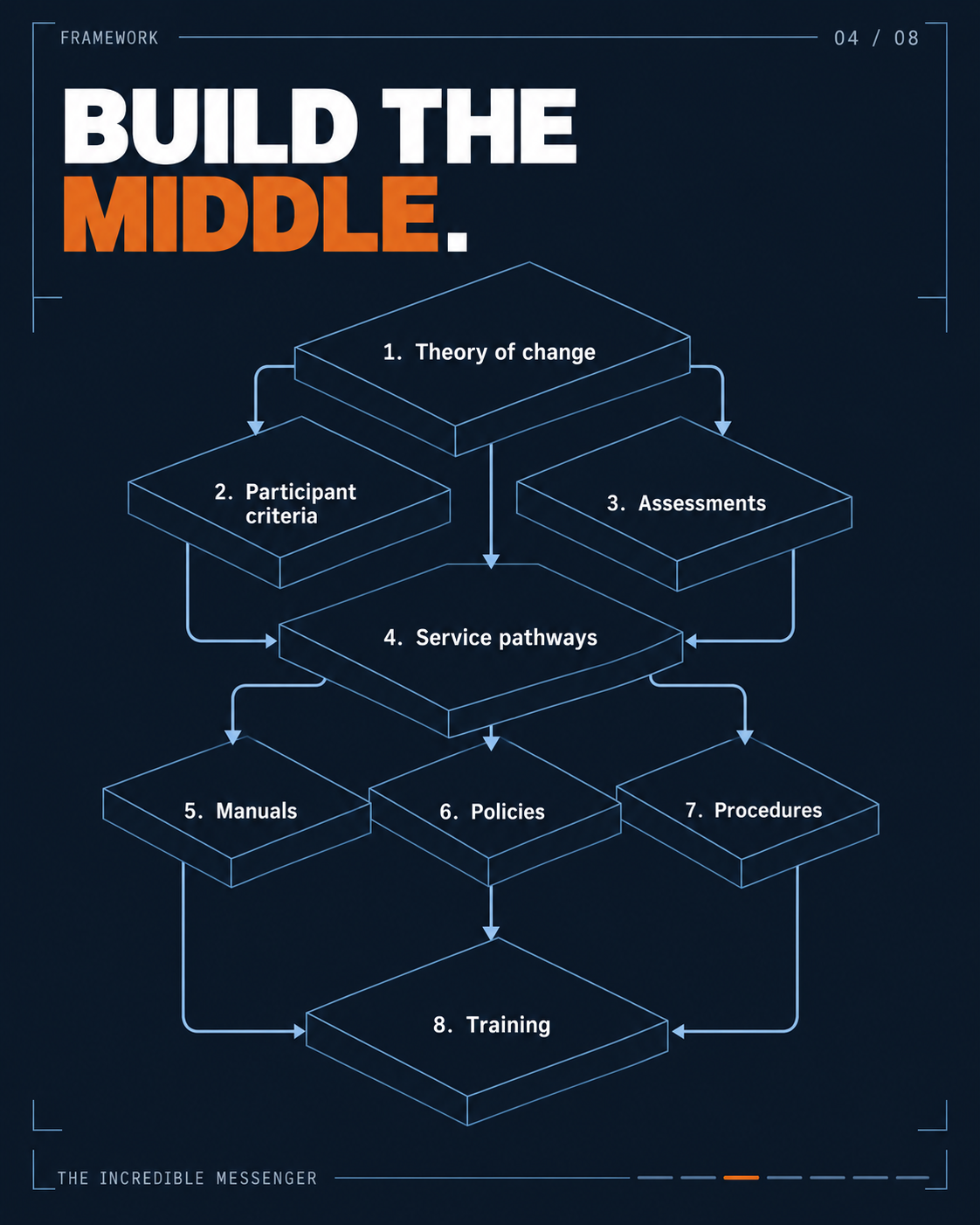
Build the Middle: a diagram connecting a theory of change with participant criteria, assessments, service pathways, manuals, policies, procedures, and training.

The operating structure that connects a program idea to everyday delivery.

View full-size graphic (opens in a new tab)
Read graphic text
  • A theory of change connects to participant criteria, assessments, and service pathways.
  • Service pathways connect to manuals, policies, and procedures. These support training.
  • The eight elements are: theory of change; participant criteria; assessments; service pathways; manuals; policies; procedures; training.

From diagnosis to delivery

Soren Tsui's episode sequence shows how a plan moves from understanding the harm to selecting, building, and resourcing an intervention.

Silent animation · 65 seconds. Use the player controls to play, pause, or replay.

View completed still (opens in a new tab)
Read the graphic sequence
  1. Diagnose: understand what is driving violence, including who is affected and what patterns matter.
  2. Select: match the intervention to the diagnosis rather than treating every problem as the same.
  3. Build: turn the idea into a deliverable intervention with program manuals, policies, procedures, and training.
  4. Resource: invest in the organizations doing the work, including staff, operational support, and the capacity to implement well.
ICM field application · illustrative

Trace one part at a time

Select a part to see what it does, where it can break down, and a next step your team can try. These are ICM planning examples drawn from the episode.

Diagnose

Understand the harm and the conditions driving it before choosing a response.

Where it breaks
A familiar model is selected before the team agrees on the problem.
Next move
State the population, patterns, and plausible drivers in a brief shared diagnosis.
Who needs to act
Jurisdiction lead, analysts, community partners, and affected residents.
Check the delivery
Can each partner connect the proposed response to a specific part of the diagnosis?
See the episode context and illustrative example

Illustrative local situation · ICM application

Put the framework against a decision.

A city approves a violence prevention plan in January. By spring the contract is unsigned, hiring has stalled, and the service partner cannot begin outreach.

The decision
Put a real start date and dependency owner beside each step: award, contract, payment, hiring, training, referral agreement, and first service.
Who can act
The office and procurement team resolve approvals; the provider confirms staffing and readiness. The budget holder can move resources when a delay changes the plan.
Check what happened
Compare promised dates with actual service and ask the people meant to receive it whether they could access it. An approved plan is not delivered service.
Trace the implementation chain

These are parts of the picture to examine, not a complete plan for a jurisdiction or organization. The right design depends on local conditions, authority, resources, and the people who must carry it out.

How the pieces connect

  • Policies define what programs are allowed and required to do.
  • Written procedures turn policy into consistent daily practice.
  • Staffing, training, supervision, and working conditions affect service quality and continuity.
  • Funding and contracting timelines determine whether services are available when they are needed.
  • Regular reviews connect data to decisions and corrective action.

Where the work can break down

  • Funding is approved, but contracts begin after the period of greatest need.
  • A program depends on one leader to solve every operational problem.
  • Programs spend time reporting data that no one uses to make decisions.
  • Frontline workers are held responsible for results without adequate authority, staffing, or support.